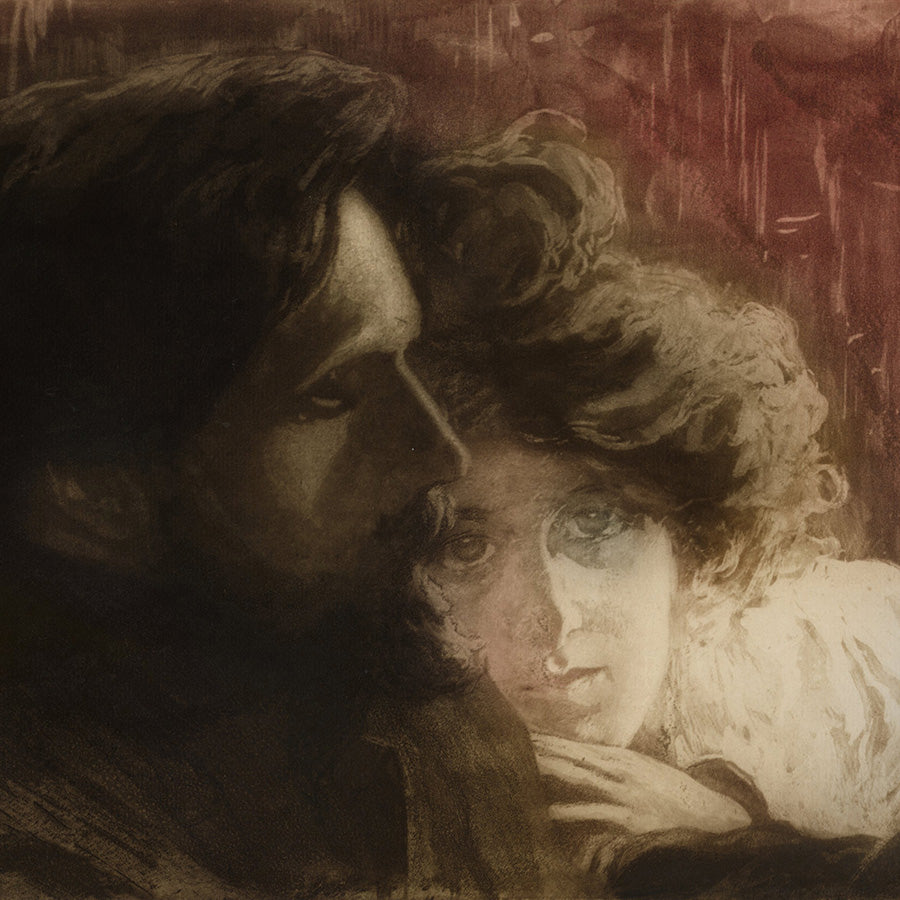


Lugné-Poé, dans "Image"
Lithograph printed in black ink on wove paper.
References: Delteil 57; Wittrock 49.
Edition of 30. Distributed by Kleinmann, Paris.
About half of the edition is numbered and about half bear a red monogram stamp. Our has neither.
It is presumed that at least 15 impressions are held by museums. Considering a few impressions inevitably must have been lost, we expect no more than 10 impressions to still be held in private hands.
A very fine impression in excellent condition, with full margin.
NOTE: It is easy to forget how closely knit certain arts communities can be. Paris in the 1880s and 90s was such a place, where artists, even some who did not see eye-to-eye on artistic choices or social behaviors, were nevertheless part of the same world. The "Théâtre de l'Oeuvre" in Paris was a place where avant-garde artists gathered from 1893 to 1899. Henri de Toulouse-Lautrec loved the plays performed there and would sketch actors he admired in action. These sketches were made into some of his most famous black-and-white lithographs. Our print is one such dramatic rendering for a play which took place on 27 February 1894, titled "L’Image", written by Maurice Beaubourg. For this play, and another titled "Une Nuit d'Avril à Céos", Edouard Vuillard created a theater program (see HERE) which was distributed to patrons who attended. While Toulouse-Lautrec and Vuillard are not known to have been particularly friendly, they were clearly both in attendance during rehearsals, so they could jot down ideas for their respective compositions.
The dramatic confrontation between Marcel (played by Lugné-Poé) and Jeanne (played by Berthe Bady) is drawn by Lautrec to maximum effect. The confrontation centers around the idea that Marcel projects artistic ideals of beauty onto Jeanne, who wishes to remain her own person, rather than a frozen image rendered by an artist. Bady’s face is turned away from us, forcing us to imagine her ire from the fright depicted in Lugné-Poé’s facial expression and demeanor. He is so scared he seems to have recessed into the wall. His face suggests anger on a level he has never experienced before. Berthe Bady could give a stare, obviously (see our last image)! Toulouse-Lautrec’s expressive linework is here at its very best.