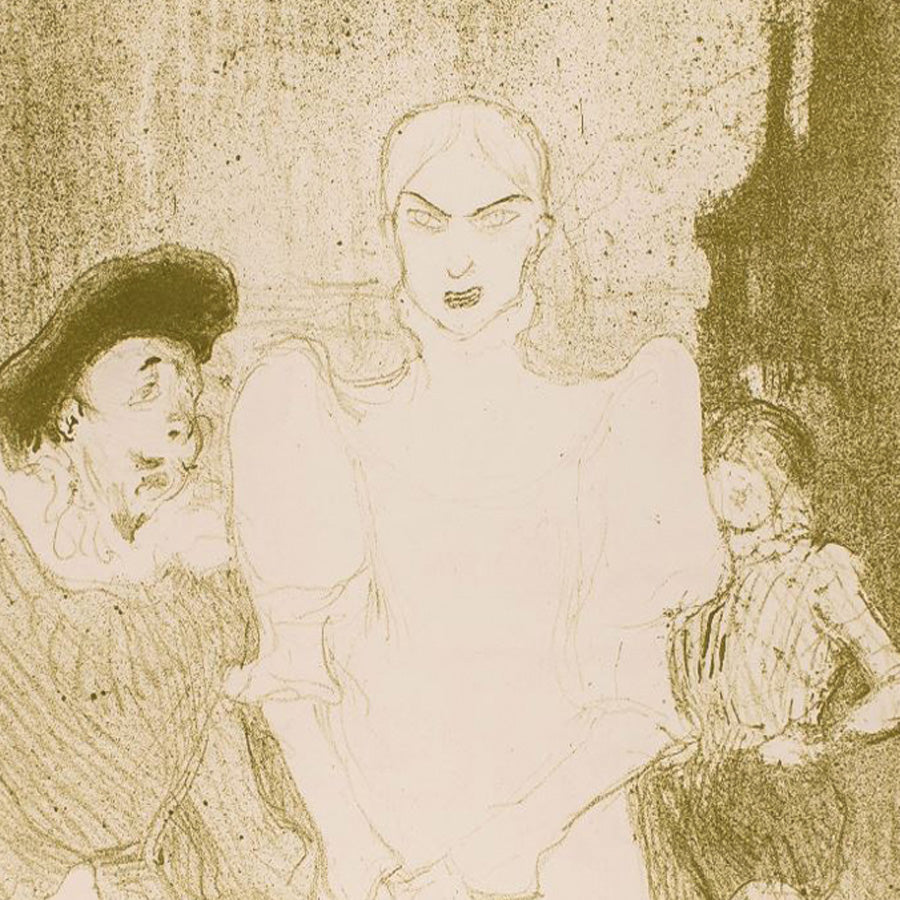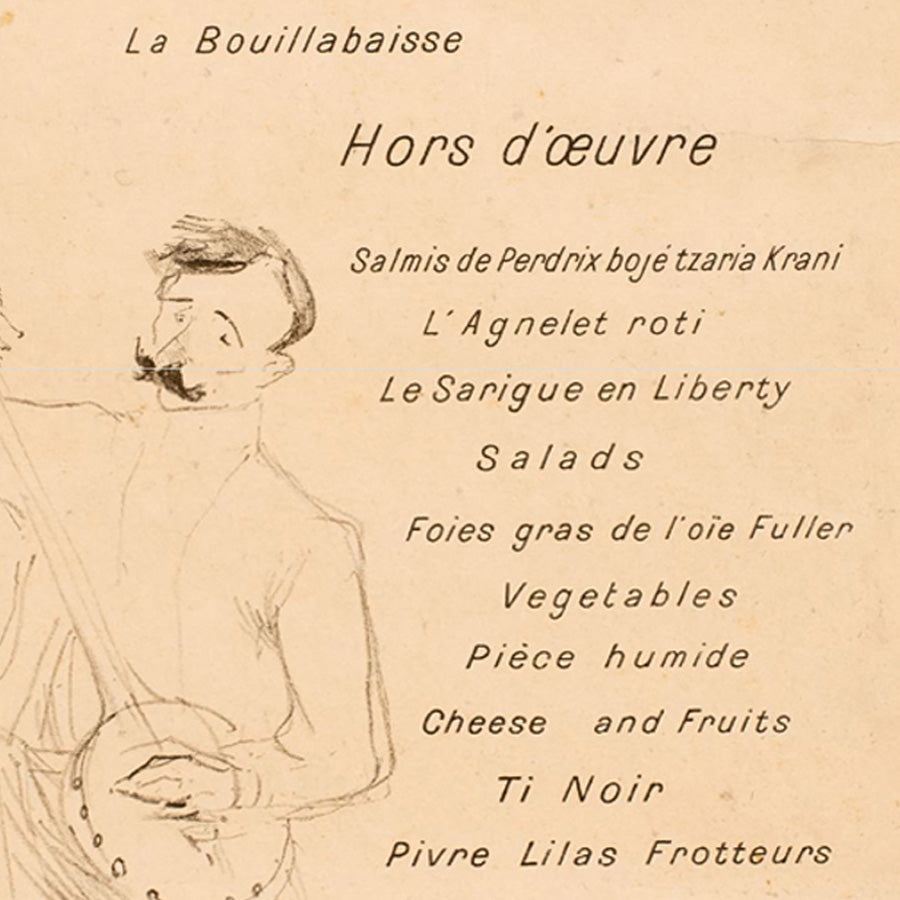


At the Moulin-Rouge: the Franco-Russion Alliance
Au Moulin-Rouge: l'Union Franco-Russe (original French title)
Lithograph printed in black ink on wove paper. References: Delteil 50; Wittrock 40.
Edition of 100. Published by L’Escarmouche and reproduced it in their January 7, 1894 issue of the magazine. Printed by Ancourt. Signed with the artist’s red monogram stamp (Lugt 1338) and numbered “24” in pencil.
A very fine impression in excellent condition, with full, small margins, as issued. Like all early lithographs by Lautrec, this one has become very hard to find in good condition.
NOTE: Both of the characters depicted in our lithograph are part of a parade that was meant as a mockery of the Franco-Russian Alliance, which had been in the works since 1892 and was ratified by France and Russia at the end of 1893 and early in 1894. This rapprochement was regarded as one of convenience, against the alliance of Germany with Austria-Hungary (the so-called Dual Alliance). Many French artists found a military collaboration between these two countries preposterous to the point of making fun of it. Of course, the irreverent and famous Moulin Rouge dance and performance hall had to comment. A parody of a military parade was organized, by assembling all of its regular performers into an eclectic assortment of mock soldiers showing their “might” (an advertisement poster by Roedel, for this event exists). The rearguard of this parade was made up of a man and a woman who were meant to be the personifications of France and Russia. The woman in a worker’s apron, and who personifies Russia, looks robust and healthy. She easily outflanks her skinny male companion. This couple is also depicted in another lithograph by Toulouse-Lautrec that same year, and titled "Une Redoute au Moulin Rouge". In this lithograph our two characters are seen trailing the end of the parade (see MoMA impression). Other characters are shown in in this image, clowns, and famous cancan performers La Goulue and Cha-U-Kao. In our lithograph “France” is clearly shown as a scrawny man, who smokes, reads Paris Sport and wears the typical blue de travail (workers shirt, typically blue) and the accompanying soft casquette (cap). This lithograph is one of Lautrec’s most accomplished early compositions. His draftsmanship excels.